
Custom Dining Sets: A How-to Buying Guide
Table of Contents
- Start With How You Use the Room
- A Practical Measuring Guide for Custom Dining Table Dimensions
- Wood Species, Tabletop Style, and Finish Choices
- Coordinating a Custom Dining Table and Chairs
- Budget Planning and the Real Cost Drivers
- Finding Custom Furniture Near Me: What to Ask Before You Order
- Ordering, Lead Times, Delivery, and Changes Mid-Build
- Conclusion
- Frequently Asked Questions
Last Updated: October 18, 2026
Start With How You Use the Room
Most people begin a dining room project by browsing photos. That is backwards. The families happiest with their custom dining sets start by answering a simpler question: what actually happens in this room?
A formal dining room that hosts two holiday dinners a year needs something different from the table that anchors everyday family dinners, homework, and Sunday pancakes. Before you look at a wood sample, write down three things: how many people sit down on a normal weeknight, how many you seat at your largest gathering, and whether the room doubles as a workspace, craft table, or game night headquarters.
That last point matters more than most guides admit. A multi-purpose dining room needs a durable finish and enough surface area to spread out, while a formal space can lean toward a more delicate look.
Measure your current table and note which parts of it frustrate you. Too narrow for serving dishes? Too short when the in-laws visit? That list of complaints is a better design brief than any inspiration board.
A Practical Measuring Guide for Custom Dining Table Dimensions
Custom dining table dimensions start with the room, not the table. Measure the length and width of your dining space, then subtract the clearance you need for chairs and walkways.
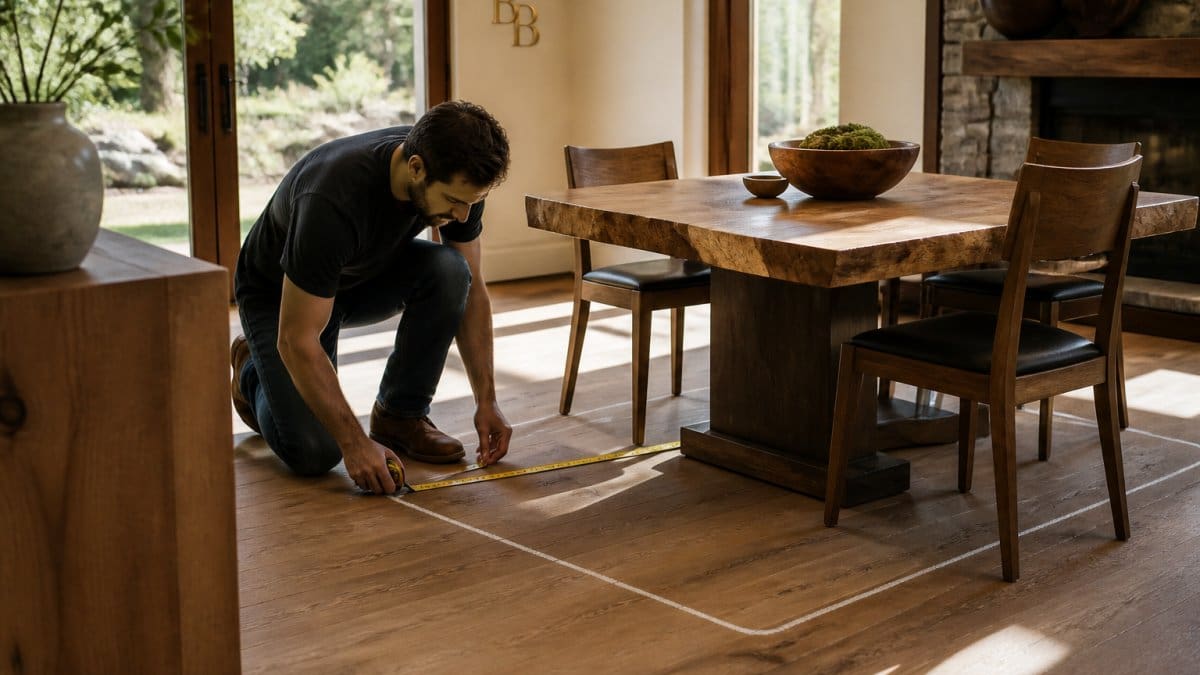
Room, Table, and Chair Clearance Numbers That Matter
Here are the working numbers we use when planning a custom size dining table:
| Measurement | Recommended Minimum | Why It Matters |
|---|---|---|
| Chair pull-out behind table | 36 inches | Lets guests push back and stand without hitting a wall |
| Walkway behind seated guests | 36-44 inches | Keeps serving traffic moving safely |
| Space per seated diner | 24 inches of table edge | Prevents elbow collisions |
| Table width | 36-42 inches | Fits place settings plus serving dishes |
| Table height | 30 inches (standard) | Matches standard dining chair seat height |
For a rectangular table, a rough starting formula is 24 inches of length per person on each side, so a table seating six needs about 72 inches. Round and oval tables change the math slightly because the curve uses space more efficiently in tight rooms.
The most common measuring mistake is forgetting the sideboard, buffet, or bar cart. If furniture sits along the wall, subtract its depth from your clearance before you order. A table that technically fits but leaves a 20-inch squeeze past the sideboard will annoy you daily.
Planning a Custom Size Dining Table for Odd or Open Spaces
Open-concept floor plans and oddly shaped rooms are where custom size dining table planning earns its keep. In an open layout, define the dining zone with a rug or lighting first, then measure within that boundary. For angled walls or bay windows, an oval or round table usually solves what a rectangle cannot.
Wood Species, Tabletop Style, and Finish Choices
Wood species, tabletop style, and finish determine how a custom dining table looks and ages.
Wood species each bring distinct traits. Ash and elm show dramatic grain patterns that suit farmhouse and rustic settings. Live edge slabs preserve the natural contour of the tree, the heart of artisan construction.
Tabletop styles cover shape (rectangular, round, oval) and the table edge.
Matching a Wood Finish to Your Home
Pull your finish cue from what is already in the room. Warm honey and amber tones suit traditional and farmhouse interiors; cool gray-brown washes lean contemporary. If your floors are warm oak, a walnut table adds contrast without clashing. Ask for physical samples and view them in your own lighting, morning and evening, before committing.
Coordinating a Custom Dining Table and Chairs
A custom dining table and chairs should share a visual language without matching too literally. Coordinate on three things: scale, wood tone, and style era.
Scale first. A heavy, thick-slab table needs chairs with enough visual weight to hold their own; delicate spindle chairs will look lost beside it.
Seating capacity drives the count. Plan two chairs per long side of a rectangular table, one at each end, and remember armchairs need more clearance than side chairs.
Budget Planning and the Real Cost Drivers
Most custom dining set guides either hide pricing or list a single starting number. Neither helps you plan. What helps is understanding which decisions move the total the most, so you can spend where it shows and save where it does not.
What Drives the Price, Ranked by Impact
The biggest cost levers on a custom dining set fall into a predictable order. Exact amounts vary by maker and region, so treat this as a ranking of impact rather than a price list:
- Slab size and species availability. A wide, single-slab walnut or white oak top costs more than a narrower top or one built from glued-up boards, because wide clear slabs are rarer and require more careful drying and handling. Rarer species and figured grain add cost on top of size.
- Tabletop style and edge work. A straight, machined edge is the least labor-intensive. Live edge, chamfered, and hand-shaped edges require more skilled handwork, the second-largest driver after the slab itself.
- Finish. A simple natural oil finish costs less in labor than a multi-step satin polyurethane or hand-rubbed schedule. The gap is modest per piece but adds up across a table and six chairs.
- Chair count and chair construction. Chairs are often the most adjustable line item. Each additional chair adds material and labor, and armchairs cost more than side chairs. Dropping from eight chairs to six, or choosing a simpler profile, is the fastest way to protect a budget.
- Base and leg design. A simple trestle or four-leg base costs less than a complex pedestal or hand-carved base. This is a place to save without sacrificing the top you love.
- Delivery and assembly. Crated freight shipping and in-home assembly add cost that is easy to overlook. Ask for this line separately so it does not surprise you at checkout.
A Simple Planning Framework
Before you request a quote, rank your priorities in three buckets: must-have, nice-to-have, and flexible. Most buyers put the slab and finish in must-have, chair count and base style in flexible, and edge detail in between.
Shop Exclusive Winter Collection →
Ask for a written quote that itemizes the table, chairs, finish, and delivery as separate lines. That lets you see what each upgrade costs and compare two makers on the same basis; a lump sum hides where the money goes and makes it hard to negotiate intelligently.
Request quotes from two or three makers using the same specifications, same species, same dimensions, same chair count. Comparing identical scopes is the only fair way to judge value, and it often reveals which maker is charging a premium for labor versus materials.
Where to Save Without Regret
The safest places to trim are chair count (seat only the people who actually sit down on a normal night), base complexity, and finish steps. The riskiest cut is slab quality, a narrow or heavily pieced top is hard to upgrade later. Lock in the top and finish you love, then adjust the flexible lines to land inside your budget.
The table is the investment; the chairs and base are the flexible line items. Lock in the slab and finish you love, then adjust chair count or base style to land inside your budget.
Finding Custom Furniture Near Me: What to Ask Before You Order
Searching for custom furniture near me works best as vetting, not browsing. The right maker answers process questions clearly and puts commitments in writing.
Ask these before you pay a deposit:
- Who actually builds the piece, and where?
- Can I see examples of finished work in my wood species and finish?
- What is the lead time, and what causes delays?
At The Bronze Burl, we are a family-owned business, and we welcome these questions. A maker who hesitates on warranty or shipping terms is telling you something.
Ordering, Lead Times, Delivery, and Changes Mid-Build
Made-to-order furniture raises practical questions product pages rarely answer: how long will it take, what happens if I change my mind, and who is responsible if the piece arrives damaged. Here is the full path, stage by stage.
The Ordering Path, Step by Step
A custom dining set typically moves through six stages:
- Consultation. You discuss room size, seating needs, style, and budget with the maker. Bring your measurements and your list of frustrations with your current table.
- Design specifications. The maker translates the conversation into a written spec: species, dimensions, tabletop shape and edge, finish, base style, chair count and style.
- Quote and deposit. You receive an itemized quote and pay a deposit to start production. Confirm what the deposit covers and whether it is refundable.
- Build. The maker selects and prepares the slab, cuts and shapes the top, builds the base and chairs, and applies the finish. This is the longest stage.
- Delivery. The finished piece is crated and shipped, then assembled in your home or delivered ready to attach legs or bases.
- Inspection and acceptance. You inspect the piece before signing the delivery receipt and confirm any issues in writing.
Lead Times: What to Expect and What Causes Delays
Lead times vary widely by maker and complexity, so ask for a written timeline with your order rather than a general estimate. Simpler pieces with standard species and finishes move faster, while wide slabs, rare species, hand-shaped edges, and large chair counts extend the timeline.
Delays usually come from a few predictable sources: slab availability (wide clear slabs are not always in stock), finish curing time (some finishes need days to cure before shipping), and seasonal demand.
Changes Mid-Build: When They Are Possible
Changes are usually easy early and difficult late. Before the slab is cut, most makers can adjust dimensions, species, or finish; once it is cut or the finish is applied, reversing course costs money and time. Ask your maker to define the cutoff point in writing, the stage after which changes are no longer accepted or carry a fee.
Delivery and Inspection
Most handcrafted dining sets ship crated by freight. Assembly is typically limited to attaching legs or bases, and some makers offer in-home assembly for an added fee. On delivery:
- Inspect the tabletop and edges before signing the receipt.
- Photograph any damage immediately, including the packaging.
- Confirm in writing who is responsible for filing freight claims.
Never sign a delivery receipt before inspecting the tabletop and edges. Once you sign, freight damage claims become far harder to win, and the burden of proof shifts to you.
Cancellation and Return Policies
Because each piece is made to order, cancellation and return policies are stricter than for stock furniture. Before you pay a deposit, ask: Is the deposit refundable, and until what stage? Can the order be canceled after production begins, and what portion is retained? What is the return window, if any, and who pays return freight? Get the answers in writing in your order confirmation.
Treat the order confirmation as a contract. The written timeline, change cutoff, delivery inspection steps, and cancellation terms are what protect you if something goes wrong.
Conclusion
Designing custom dining sets asks you to make a dozen small decisions, and the families who love their tables are the ones who measured first, prioritized their budget honestly, and asked hard questions before ordering. If you want a table built to be enjoyed for years, with the character of natural wood and the warmth of handcrafted work, explore what we make.
Frequently Asked Questions
How do I choose the right size for a custom dining set?
Measure the room first, then work backward. Leave about 36 inches between the table edge and walls or other furniture so chairs can slide out. Plan roughly 24 inches of table width per seated person and 12 to 15 inches of depth per place setting. For a custom size dining table in a tight room, an oval or round top gains seating without blocking walkways. Bring your room measurements and seating count to a designer consultation so the custom dining table dimensions are set before any wood is cut.
How do I choose chairs that work with a custom dining table and chairs set?
Check three numbers: seat height, apron clearance, and chair width. A standard seat height of 18 inches pairs with a 30-inch tabletop; counter-height sets run about 24-inch seats with 36-inch tops. Make sure the chair back fits under the table edge if you want to tuck them in. For a custom dining table and chairs pairing, measure the total width of your chairs side by side and compare it to the table length, then confirm the leg style leaves room for chair frames.
Which wood is best for a custom dining table?
It depends on how hard the table will work. Walnut and white oak hold up well to daily family dinners and take a hand-finished oil or lacquer beautifully. Maple and cherry are dense and age with a warm patina. Softer species like pine show dents faster, which suits a farmhouse style but not a formal dining room. Ask about how the wood was dried and how the top is finished, since those steps affect durability more than the species name alone.
Are custom dining sets worth the cost?
Custom dining sets usually cost more than mass-market sets because you pay for made-to-order sizing, solid wood, and handcrafted construction rather than a standard box size. The trade-off is a piece built for your room and your seating count, with a timeless design you can refinish instead of replace. Ask each maker for details on joinery, finish, and warranty before you commit. Pricing depends on size, wood species, and finish, so request a custom quote from the maker for current figures.