
How to Find a Live Edge Dining Table Near You
Table of Contents
- Start Your Search: A Practical Workflow for Finding a Live Edge Dining Table Near Me
- What to Look for in Custom Live Edge Dining Table Makers
- Live Edge Dining Table Cost: What Drives the Price
- Live Edge Dining Table Sizes: Getting the Dimensions Right
- Where to Buy Solid Wood Dining Tables: Local vs. Online
- How to Evaluate a Live Edge Table in Person
- Delivery, Care, and Long-Term Ownership
- Frequently Asked Questions
Last Updated: October 21, 2026
Start Your Search: A Practical Workflow for Finding a Live Edge Dining Table Near Me
Finding a live edge dining table near you starts with one rule: search by craft, not by keyword. Most buyers type “live edge dining table near me” into a map app and get showrooms that may not build anything.
A live edge dining table is a dining table built from a solid wood slab that keeps the tree’s natural outer contour, called the live edge or natural edge, on one or both sides. The bark line stays, the grain runs wide, and no two tops match.
Here is the workflow we would follow:
- Search “custom live edge dining table makers” plus your metro area, not just the product name.
- Filter for shops that show their workshop, not only finished photos.
- Check whether slabs are kiln-dried and where the wood comes from.
- Ask for table dimensions and base options before you visit.
- Book a showroom visit and inspect the slab in person.
The U.S. Forest Service guide to wood as an engineering material is a useful primer on why drying and grain direction affect how a slab behaves over time. Read it before you compare quotes.
Search by the maker’s craft term, not the product term. Shops that build custom tables often rank for “custom furniture” or “woodworking shop” and never for “live edge table near me.” You will miss the best workshops if you only search the product phrase.
What to Look for in Custom Live Edge Dining Table Makers
Judge custom live edge dining table makers on four things: how they source and dry wood, how they join the base to the top, how they finish, and whether they let you see work in progress. Everything else is marketing.
Ask these questions before you commit:
- Where does the wood come from? Local makers should be able to name the species and the source. Salvaged wood and reclaimed wood from regional trees are common in the Pacific Northwest.
- Is the slab kiln-dried? Kiln-dried slabs are dried in a controlled kiln to a stable moisture level, which limits cracking and movement after delivery.
- How is the base attached? Wood moves with the seasons. A good base allows for that movement instead of fighting it.
- What finish do you use? Ask for the product name and how many coats.
- Can I see the slab before it is finished? Slab selection matters. You want to choose your own top.
A common mistake is buying from a shop that cannot answer the drying question. A slab air-dried in a garage and rushed to finish may cup or split in your dining room.
Never buy a live edge table from a seller who will not let you see the actual slab you are purchasing. Photos of a “similar” table are not the same as the board that will sit in your home. Grain, natural variation, and edge shape change everything.
Live Edge Dining Table Cost: What Drives the Price
Live edge dining table cost depends on the slab, not labor hours alone.
Here is what moves the price up or down:
| Cost Driver | What Raises the Price | What Lowers It |
|---|---|---|
| Wood species | Walnut, highly figured boards | Maple, standard white oak |
| Slab width | Wide single slab tops | Two narrower boards joined |
| Drying and prep | Kiln-dried, stabilized slabs | Air-dried, less prep |
| Base style | Hand-shaped steel or hardwood bases | Simple trestle designs |
| Finish | Multi-coat protective finish | Basic oil and wax |
| Lead time | Rush orders | Standard made-to-order schedule |
Realistic price bands. Because pricing varies widely, ask each maker for a detailed quote that breaks down slab selection, base, finish, and shipping.
Lead times. Standard made-to-order live edge tables typically run several weeks from deposit, depending on backlog and whether the slab is already dried and flattened.
Delivery and installation. Local delivery often runs a certain amount and may include inside placement and setup. White-glove delivery with stairs or elevator access costs more.
Be wary of any maker who quotes a firm number before asking about size and species, that signals a catalog product, not a custom table.
Ask for the quote broken into slab, base, finish, and delivery. A single lump sum hides where the money is going and makes it hard to compare two makers fairly.
Live Edge Dining Table Sizes: Getting the Dimensions Right
Live edge dining table sizes come down to two numbers: length and width. Get those wrong and no amount of beautiful grain will save the room.
Start with seating. A common approach is to allow about 24 inches of table length per person on each side. That gives everyone elbow room without a cramped feel.
- Seats 4: roughly 48 to 60 inches long
- Seats 6: roughly 72 to 84 inches long
- Seats 8: roughly 96 to 108 inches long
- Width: 36 to 42 inches is comfortable for most dining rooms
Now measure the room, not just the table. Leave at least 36 inches between the table edge and any wall or doorway so chairs can pull out. Tape the footprint on the floor before you order.
Shop Exclusive Winter Collection →
Live edge tops are irregular, so the widest point may be several inches wider than the narrowest. Ask the maker for the minimum and maximum width, then plan for the larger number.
Measure your room, tape the table footprint on the floor, and live with it for a day. Custom sizing is easier to change before the slab is cut than after it is finished.
Where to Buy Solid Wood Dining Tables: Local vs. Online
Where to buy solid wood dining tables is really a question about risk and access. Buying local lets you inspect the slab, meet the maker, and handle delivery yourself. Buying online widens your choice but adds shipping risk on a heavy, fragile piece. Here is how to find and verify a maker who is genuinely nearby, then decide which route fits you.
A practical local-search workflow
- Search maps, not just web results. Search “custom live edge furniture,” “slab table maker,” or “hardwood furniture workshop” plus your metro area. Map results surface shops with a physical address, the first filter for “near me.”
- Check maker directories. Look at the directories maintained by woodworking guilds and craft organizations, and search for local sawmills that sell slabs, many mills know which makers buy from them.
- Look for furniture districts and maker spaces. Older industrial corridors and design districts often cluster woodshops. A shared maker space may house a table builder who does not rank for the product term.
- Ask in local woodworking communities. Regional woodworking forums, subreddits, and maker groups are where buyers ask for shop recommendations. Search those threads before you post.
- Verify the seller is genuinely nearby. Confirm the address is a workshop or showroom, not a virtual office, and ask whether you can visit and see slabs in person. A local maker will invite you in; a reseller will deflect.
Local advantages
- You see the grain and natural edge before you buy.
- You can visit the showroom and ask questions face to face.
- Pickup or local delivery is simpler and cheaper.
- If something goes wrong, you have a physical address to return to.
Online advantages
- Access to makers outside your area.
- Larger selection of wood species and slab widths.
- Sometimes lower prices in regions with cheaper hardwood.
The trade-off is real
A live edge top is heavy and awkward to ship. Ask any online seller who handles damage claims, what the packaging looks like, and whether delivery includes bringing the table inside, and get it in writing. Ask local sellers the same questions; a local maker without inside delivery still leaves you moving a 200-pound top yourself.
Compare the four buying routes
| Route | Customization | Price | Wait time | Can you inspect the slab? |
|---|---|---|---|---|
| Local custom maker | High | Mid to high | 6-12 weeks | Yes |
| Ready-made retailer | Low | Low to mid | In stock | Sometimes, in store |
| Reclaimed furniture shop | Mid | Mid | Varies | Often |
| Online custom seller | High | Mid to high | 8-16 weeks | No, photos only |
If you are outside the Pacific Northwest, style is not a barrier. A walnut or white oak live edge table reads as warm and modern in a Midwest dining room just as well as in other regions.
Search by craft term, verify the address is a real workshop, and visit before you commit. If you cannot visit, treat the online route as a higher-risk purchase and get damage, delivery, and return terms in writing.
How to Evaluate a Live Edge Table in Person
Evaluating a live edge table in person takes about fifteen minutes if you know what to check. Bring a tape measure, a notebook, and a small flashlight.
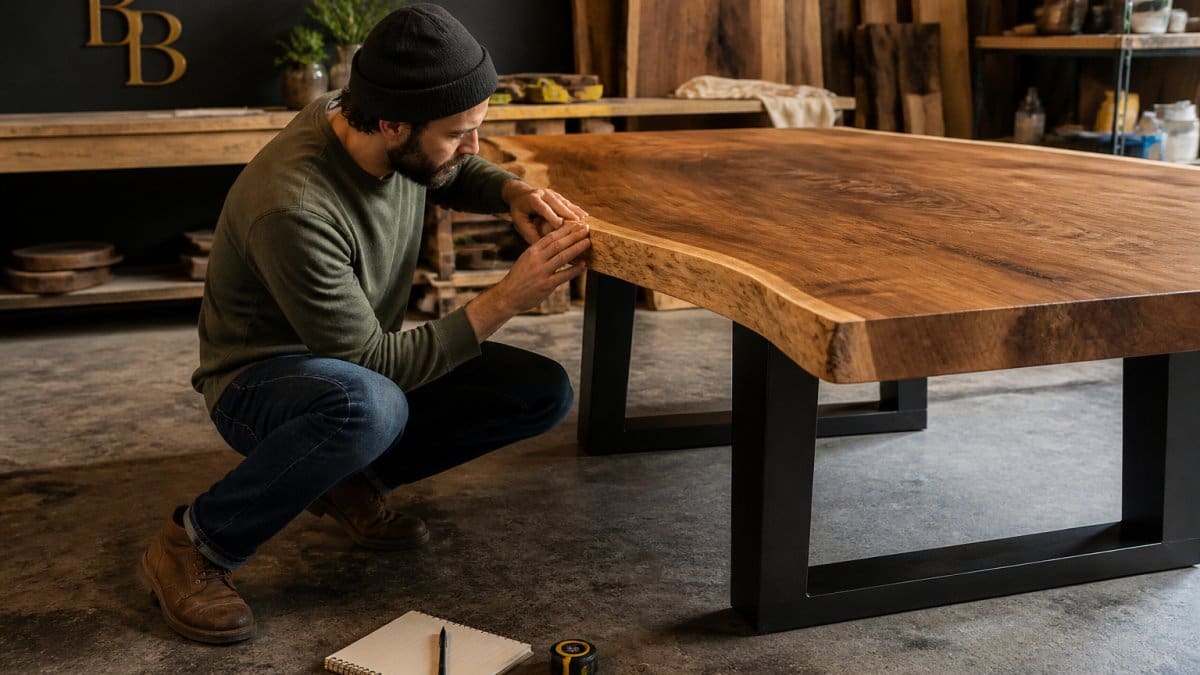
Run through this checklist:
- Run your hand along the edge. It should feel smooth, with no splinters or sharp bark pockets.
- Check for cracks and checks. Small surface checks are normal in slab wood. Deep splits that run through the top are not.
- Look at the grain across the whole top. Consistent grain and color mean the slab was chosen well.
- Press on the top. It should not flex or rock. A solid base should feel planted.
- Look underneath. Check how the base attaches and whether the maker allowed for wood movement.
- Feel the finish. It should be even, with no tacky spots or drips.
- Ask about the moisture content. A kiln-dried slab should be stable and ready for a home.
If the shop will not let you do this, walk away. A confident maker will hand you the flashlight.
Delivery, Care, and Long-Term Ownership
Delivery logistics decide whether a great table arrives in one piece. Measure every doorway, stairwell, and elevator on the path to your dining room before the table ships.
Ask the seller:
- Does delivery include bringing the table inside and setting it up?
- Who is responsible if it arrives damaged?
- What is the return or repair policy?
For care, keep it simple: dust with a soft cloth, wipe spills quickly, keep the table out of direct sun and away from heating vents, and use coasters under hot dishes.
A well-made solid hardwood table is meant to be lived with. Small marks and patina are part of the story, not a defect.
Finding a live edge dining table near you takes more than a map search. It takes the right questions, a tape measure, and a maker who will show you the slab.
Frequently Asked Questions
How much do live edge tables cost?
Live edge dining table cost depends on the wood species, slab size, base style, and finish. Larger single slabs of walnut or white oak typically cost more than smaller reclaimed pieces. Custom work from local makers often includes design time and delivery. Because pricing varies widely, ask each maker for a detailed quote that breaks down slab selection, base, finish, and shipping. The Bronze Burl provides current pricing on its website rather than fixed estimates.
How do I choose the right size live edge dining table?
Aim for at least 24 inches of table width per person and 12 inches of depth for place settings. For a family of four, a table around 72 inches long and 36 to 40 inches wide works well. Measure your room and leave 36 inches of clearance around the table for chairs and walking space. Live edge dining table sizes vary because natural edges are irregular, so confirm the widest and narrowest points before ordering.
Is it better to buy a live edge table locally or online?
Buying locally lets you inspect the slab in person, check the finish and joinery, and avoid shipping damage. Online shopping expands your options and can connect you with custom live edge dining table makers outside your area. If you buy online, ask for detailed photos, a video walkthrough, and the maker’s damage policy. Many local shops also list inventory online and offer pickup or delivery within a service area.
What should I ask before buying a live edge dining table?
Ask about the wood species, where the slab was sourced, and whether it was kiln-dried to prevent cracking. Confirm the base style, finish type, and expected lead time. Request the table’s exact dimensions at the widest and narrowest points. Also ask about delivery logistics, who handles damage claims, and what care is needed in the first year. These questions help you compare makers and avoid surprises after purchase.