
Timeless Furniture Delivery: What Actually Lasts
Table of Contents
- Why Timeless Furniture Delivery Starts With the Piece, Not the Truck
- Timeless Furniture Styles That Outlast Trends
- Durable Furniture Materials: What Holds Up Over Decades
- How to Choose Furniture That Lasts (And Arrives Intact)
- The Furniture Delivery Checklist Every Buyer Needs
- Delivery Risk by Furniture Type: What to Expect
- Conclusion
- Frequently Asked Questions
Last Updated: October 16, 2026
Why Timeless Furniture Delivery Starts With the Piece, Not the Truck
The best timeless design for reliable furniture delivery is a piece built so well that it survives the trip. That sounds obvious. It isn’t.
Most buyers research shipping first: carrier options, delivery windows, tracking.
Here’s the throughline for this guide: delivery reliability is a design outcome, not a logistics outcome. The Federal Trade Commission’s guidance on furniture labeling and care claims is worth reading for what sellers must disclose, but the physical reality is what protects your purchase.
Below, we break down timeless furniture styles, the durable furniture materials that hold up over decades, and a delivery checklist you can run before you buy.
Timeless Furniture Styles That Outlast Trends
Most style guides hand you a label, midcentury, organic modern, Scandinavian, and stop there. Labels are not useful when you are spending real money on a piece you expect to keep for twenty years.
Here are the four indicators worth checking, in order of how much they affect longevity:
- Adaptable proportions. A sofa with a seat height around 17 to 19 inches, a dining table 28 to 30 inches tall, and a side table 22 to 26 inches tall will work with almost any future seating, rug, or room layout. Pieces sized to a single trend (very low platform sofas, very tall bar-height dining sets) are the ones that get replaced when the room changes.
- Neutral foundations. Wood tones, stone, leather, and undyed textiles accept new paint, new rugs, and new lighting without a fight. A saturated color or a novelty finish locks the piece to one palette. This is why a walnut table survives three redecorations and a teal lacquer console rarely survives one.
- Enduring materials. Solid hardwood, stone, wool, linen, and full-grain leather patina rather than degrade. Veneer over MDF, bonded leather, and printed fabrics fail at the surface first, which is the most visible and least repairable place to fail.
- Repairable construction. Visible joinery, removable cushions, replaceable legs, and finishes that can be spot-repaired all extend service life. A piece you can reupholster or refinish is a piece you can keep.
Style families still matter, but as a filter on top of those indicators, not a substitute for them:
- Live edge and organic modern. The natural edge is the ornament, so there is no applied detail to date. The form comes from the tree.
- Midcentury lines. Tapered legs, low profiles, and warm wood tones have cycled in and out of fashion for seventy years without disappearing.
- Contemporary with restraint. Clean geometry, honest materials, minimal hardware. Contemporary ages well when the detailing is quiet.
The practical test is to imagine the piece stripped of its finish. If the shape still works in bare wood, it will work in any room, in any decade.
When you evaluate a piece online, look for photos from three angles: the joint where the leg meets the seat or apron, the underside, and the edge profile. Sellers who show the underside are usually proud of it. Sellers who only show the top are usually hiding something.
A second test that costs nothing: search the retailer’s catalog for the same silhouette in a different finish. If the shape holds up across three or four finishes, the design is doing the work. If it only looks right in one, the finish is doing the work, and finishes date faster than shapes.
Durable Furniture Materials: What Holds Up Over Decades
The materials that survive decades are hardwood, properly dried, joined with mechanical reinforcement, and finished with something repairable. Everything else is a shorter conversation.
Solid hardwood, whether walnut, oak, maple, or cherry, moves with humidity but holds its structure. Kiln drying matters more than species.
Upholstery tells the same story. A hardwood frame with eight-way hand-tied springs and dense foam outlasts a softwood frame with sinuous springs and low-density foam by a wide margin.
A common mistake is judging durability by weight alone. A heavy piece can still be heavy because of a thick particleboard core. Ask what the frame is made of, not how much it weighs.
How to Choose Furniture That Lasts (And Arrives Intact)
Choosing furniture that lasts means evaluating construction and delivery risk together, because a great piece that arrives cracked is a bad purchase. Run these checks before you commit:
- Joinery: Look for mortise-and-tenon, dovetail, or doweled joints with mechanical fasteners. Staples alone are a warning sign.
- Finish: A repairable oil or hardwax finish can be touched up locally. A thick factory lacquer cannot.
- Moisture content: Reputable makers dry hardwood to a stable range for the destination climate. Ask.
- Crating: Furniture delivery should include corner protection, blanket wrap, and a rigid crate for large slabs. Loose cardboard is not enough.
- Insurance and damage claims: Confirm in writing who is responsible if the piece arrives damaged, and what the window is for filing a claim.
- Assembly service: Ask whether white-glove delivery is available, and whether the carrier will place the piece in the room of your choice.
The U.S. Consumer Product Safety Commission’s furniture stability information is a useful reference for safety-related questions, particularly for tall case goods. For the buying decision itself, the checklist above covers the practical ground.
| Check | What to Look For | Why It Matters |
|---|---|---|
| Joinery | Mortise-and-tenon, dovetail, dowels | Structural life over decades |
| Finish | Oil or hardwax, repairable | Local touch-ups, no full refinish |
| Moisture content | Stable, climate-matched drying | Prevents cupping and splitting |
| Crating | Rigid crate, corner protection | Survives cross-country shipping |
| Damage claims | Written policy, clear window | Protects your money |
| Assembly | White-glove, in-room placement | Reduces handling damage |
The Furniture Delivery Checklist Every Buyer Needs
A furniture delivery checklist is only useful if it maps to what actually happens between checkout and the moment the truck leaves your driveway.
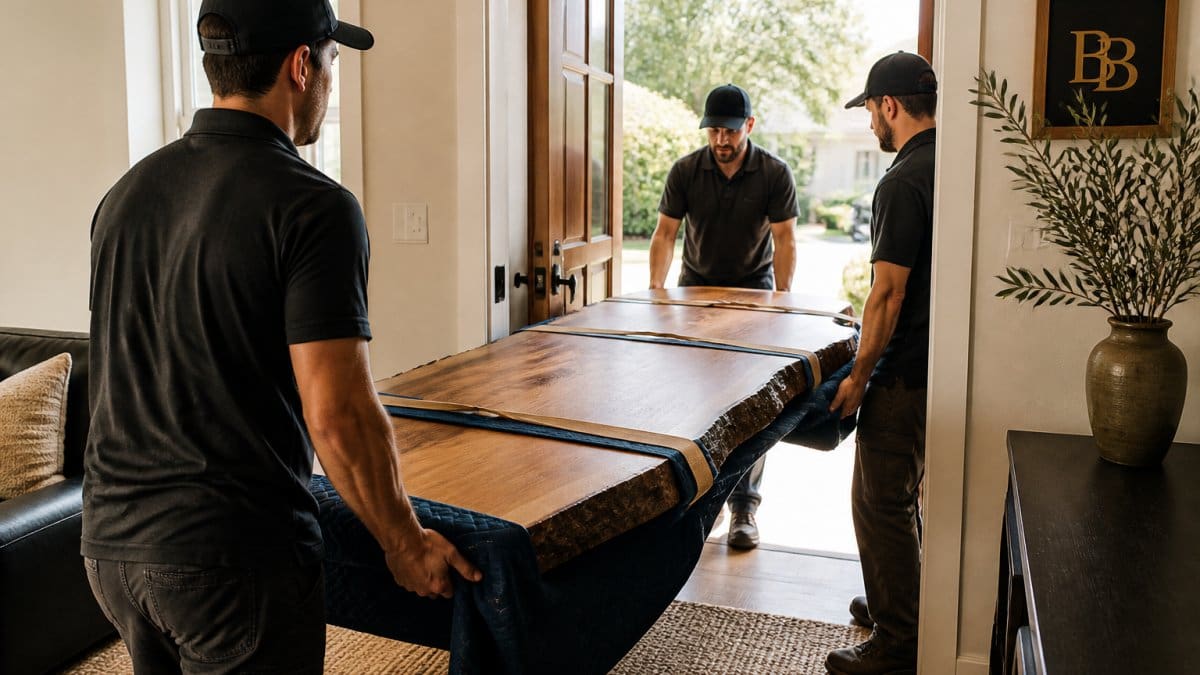
Work through the list in this order, because each stage constrains the next.
Before you pay
Shop Exclusive Winter Collection →
- Confirm your address is inside the delivery area, and whether that area is defined by ZIP code, radius, or carrier network
- Ask whether shipping is flat-rate or distance-based, and whether the quote includes liftgate, stairs, or ferry surcharges
- Get the return policy in writing, including who pays return freight and whether custom or made-to-order pieces are excluded
- Confirm the damage claim window, commonly 48 to 72 hours from delivery, and what evidence is required (photos, signed bill of lading, unboxing video)
- Ask what the warranty covers and, more importantly, what it excludes
Once the order is placed
- Ask how scheduling works: will you get a call, a text, or an online portal, and how far in advance?
- Confirm the delivery window length. A four-hour window is standard for white-glove; a full-day window usually means a shared freight route
- Confirm tracking. Some carriers provide live GPS, some provide a status page, and some provide nothing until the day of delivery
- Ask what happens if you miss the delivery. Re-delivery fees, storage fees, and return-to-sender policies vary widely and are rarely disclosed upfront
- Confirm the assembly service level in writing: threshold (curbside), room of choice, or full setup with packaging removal
On delivery day
- Inspect the crate or blanket wrap before signing anything
- Open and inspect the piece with the driver present, not after they leave
- Photograph every side, the underside, and any damage before signing the bill of lading
- Note any damage on the delivery paperwork itself, a signature without a written exception is often treated as acceptance of condition
- Keep all packaging until you have confirmed the piece is undamaged and functioning
That last item matters more than most buyers expect. A lifetime guarantee on a joint is meaningful.
The single most common delivery mistake is signing the bill of lading before inspecting. Once you sign clean, the carrier’s liability typically ends and your only recourse is the retailer’s damage policy, which may be narrower than the carrier’s.
The single most useful question you can ask a furniture retailer is: “If this arrives damaged, walk me through exactly what happens next.” Clear answers signal a real process. Vague answers signal a fight.
One more question worth asking before you commit: who actually delivers the piece? Many retailers sell direct but hand the last mile to a third-party white-glove network. That is fine, but it means the retailer’s promises and the carrier’s practices are two different things. Ask for the carrier name and look up its damage and re-delivery policies separately.
Delivery Risk by Furniture Type: What to Expect
Delivery risk scales with size, weight, and how many rigid planes a piece has. Understanding that helps you set expectations and choose the right service level.
Large dining tables and live edge slabs carry the highest risk. They are heavy, wide, and vulnerable at the corners and along the natural edge. These need rigid crating and, ideally, white-glove delivery with in-room placement.
Smaller home furnishings, decor, and botanicals ship with far less risk, which is why many buyers start there before committing to a large piece. The U.S. Department of Transportation’s guidance on household goods moving covers your rights when a carrier handles your belongings, and the same principles of documentation apply to furniture freight.
If you are ordering from outside the region a maker operates in, ask directly how they handle long-distance freight.
Conclusion
The hard part of buying timeless furniture isn’t picking a style. It’s confirming that the piece was built to survive the trip and the decades after it.
At The Bronze Burl, we build handcrafted live edge furniture from our family-owned workshop, with locally grown botanicals and nature-inspired home décor rounding out the collection. Every piece is designed to bring warmth and character to your home and to be enjoyed for years, not seasons.
Frequently Asked Questions
What style of furniture is timeless?
Timeless furniture styles share a few traits: simple lines, balanced proportions, and materials that age well like solid wood, stone, or metal. Midcentury modern, Shaker, and Scandinavian designs tend to stay relevant because they avoid ornate trends. Live-edge pieces also qualify when the wood grain and natural form are the focal point. The test is whether the piece would look at home in a room from 20 years ago and 20 years from now.
How can I tell if furniture is built to last?
Look at the joinery first. Dovetail joints, mortise-and-tenon construction, and corner blocks signal quality. Check the weight: solid wood feels dense compared to particleboard. Ask about the finish and whether it can be repaired. A lifetime guarantee or warranty is a strong signal, but read what it actually covers. For delivery, confirm the piece is crated and insured before it ships.
What should I check before ordering furniture for delivery?
Measure your doorways, hallways, and stairwells, not just the room. Confirm the delivery service offers tracking, scheduling, and a damage claims process. Ask whether assembly is included and who handles returns. Get the service area and shipping costs in writing. A furniture delivery checklist helps you avoid surprises. For large live-edge pieces, ask how the item is packed and whether the carrier has experience with oversized furniture.
How can I make sure furniture delivery is reliable?
Choose a retailer that provides verified reviews, clear delivery scheduling, and a stated damage policy. Ask if the delivery team places the piece in your room of choice and removes packaging. Confirm insurance coverage before the truck leaves. Reliable furniture delivery also means you can track the shipment. If the provider cannot answer basic questions about their process, that is a warning sign.
Is solid wood furniture a good long-term investment?
Solid wood furniture often outlasts veneer or particleboard by decades. It can be sanded and refinished, which extends its life further. The total cost of ownership tends to be lower because you replace it less often. That said, not all solid wood is equal. Kiln-dried hardwoods resist warping better than softwoods. For heirloom-quality pieces, ask about the wood source and how the piece was finished.
What furniture materials age well over time?
Solid hardwoods like oak, walnut, and maple develop character with age. Stone and metal also hold up well when properly finished. Avoid materials that cannot be repaired, such as heavily laminated particleboard or bonded leather. Natural finishes that can be touched up are better than sealed coatings that chip. For live-edge furniture, the natural edge and grain become more distinctive over time, which is part of the appeal.