
How to Choose a Live Edge Wood Slab: 2026 Guide
Table of Contents
- Start With Your Project, Not the Slab
- The Best Wood for Live Edge Tables: Species That Hold Up
- How to Tell If a Wood Slab Is Dry and Stable
- Live Edge Slab Sizes for Dining Tables and Bar Tops
- Assessing Slab Quality: Grain, Live Edge, and Defects
- The Complete Live Edge Slab Inspection Checklist
- Live Edge Wood Slab Cost and Usable Yield
- What to Ignore When Choosing a Live Edge Slab
- Frequently Asked Questions
Last Updated: October 14, 2026
Start With Your Project, Not the Slab
Learning how to choose a live edge wood slab starts with the finished piece, not the raw board.
Before you look at any wood, answer three questions:
- What is the piece? A dining table, a bar top, a bench, a console?
- Where will it live? Room size and traffic change everything.
- Who uses it daily? Kids, pets, and dinner parties all leave marks.
Write them down, they become your filter for every slab.
Match the Slab to Its Intended Use
A dining table needs a hardwood that resists dents from daily plates and elbows. A bar top takes spills and standing weight, so it wants a dense, closed-grain species.
Get this match wrong and no finish will save the piece: a soft slab under a hot casserole dish will scar, and a thin slab on a long dining table will sag.
The Best Wood for Live Edge Tables: Species That Hold Up
The best wood for live edge tables is a domestic hardwood with tight grain and good density, like walnut, oak, or maple. These resist dents and hold their shape far better than softwoods.
Here is how the common options compare:
| Species | Type | Best For | Watch Out For |
|---|---|---|---|
| Walnut | Hardwood | Dining tables, statement pieces | Higher cost, softer than oak |
| Oak | Hardwood | Heavy-use tables, bar tops | Bold grain can dominate a room |
| Maple | Hardwood | Clean, modern looks | Fewer dramatic grain patterns |
| Elm | Hardwood | Character-rich tables | Can be harder to source |
| Pine | Softwood | Accent pieces, low-traffic use | Dents easily |
| Cedar | Softwood | Outdoor and rustic pieces | Too soft for daily dining |
Domestic Hardwoods vs. Exotic Wood
Domestic hardwoods like walnut, oak, elm, and maple are grown and milled close to home, usually more stable after drying and easier to source responsibly. Exotic wood offers striking color but costs more and carries a murkier supply chain.
For most homes, a domestic hardwood wins. It ages well, repairs cleanly, and fits many interiors.
Ask where the slab was milled, not just what species it is. Two walnut slabs from different regions can behave very differently once they settle into your home.
How to Tell If a Wood Slab Is Dry and Stable
The number one question we get is how to tell if a wood slab is dry. A stable slab has been dried slowly and evenly, kiln-dried in a controlled chamber, or air-dried over months or years and just as good if done with care.
U.S. Forest Service Wood Handbook on moisture and wood explains how wood shrinks and swells as moisture changes. That movement is what you are trying to control.
Kiln-Dried vs. Air-Dried: What the Label Doesn’t Tell You
Both methods can produce a stable slab, but they behave differently in a home.
- Kiln-dried slabs reach a target moisture content in weeks, not years, with a controlled, repeatable schedule. The trade-off: a rushed kiln schedule can leave a moisture gradient, drier near the surface, wetter in the core.
- Air-dried slabs dry slowly under ambient conditions, which usually means less internal stress, many makers prefer this for thick slabs. The trade-off is time and variability: final moisture content depends on the climate where it dried, which may not match your home.
A common pattern is a slab that reads dry on the surface but holds more moisture in the center, so test more than one spot and depth.
A Practical Moisture-Measurement Guide
Check moisture yourself with a pin-type meter:
- Set the meter to the correct species group. Using the wrong group can throw readings off by several points.
- Push the pins in about one inch deep. For thick slabs, also read at roughly one-quarter thickness to check for a gradient.
- Test at least three spots: both ends and the middle. Add a fourth reading near any knot or bark inclusion, since those areas dry differently.
- Compare readings. A spread of more than a couple of points between surface and core means the slab is still equalizing.
- Aim for single digits for indoor furniture, most makers target roughly 6 to 8 percent for a heated, air-conditioned home. A slab for an unheated shop or covered porch can sit higher but will move more once inside.
Wildly different numbers mean the slab is still settling, walk away or let it dry further before building.
Bring your own meter. Seller-provided readings are a starting point, not proof. A pin-type meter costs less than a single board foot of premium walnut and pays for itself the first time it saves you from a wet slab.
Acclimation: The Step Most Buyers Skip
Even a properly dried slab needs to acclimate to its new environment before you cut or finish it.
- Sticker the slab. Stack it with thin spacers between layers so air moves across both faces; a slab flat on concrete pulls moisture from one side only.
- Give it time. A common rule is about one week per inch of thickness in a climate-controlled space, so a two-inch slab may need two weeks or more.
- Re-check moisture after acclimation. The reading should match the room’s equilibrium moisture content before you build; if it climbed, the slab needs more time.
Why Stability Matters After Installation
A slab that passes the moisture check can still move when the environment changes. Indoor humidity swings between summer and winter, and wood responds: a table built at 7 percent moisture will shrink slightly in a dry winter and swell in a humid summer.
That is normal. What is not normal is installing a wet slab: it releases moisture after the finish goes on, and the finish cracks as the wood shrinks beneath it.
A slab with a moisture gradient, dry surface, wet core, can pass a quick surface test and still fail after installation. Always take a deep reading, not just a surface one.
Live Edge Slab Sizes for Dining Tables and Bar Tops
Live edge slab sizes for dining tables follow a simple rule: allow about 24 inches of width per person and 30 inches of table depth for comfortable place settings. Too narrow forces elbows together; too long makes conversation hard.
For a dining table, aim for these targets:
- Seats 4: roughly 36 to 48 inches long, 30 to 36 inches wide
- Seats 6: roughly 60 to 72 inches long, 36 to 40 inches wide
- Seats 8: roughly 84 to 96 inches long, 40 to 48 inches wide
Bar tops run narrower, often 16 to 24 inches deep. Leave at least 36 inches between the table edge and the wall so chairs can pull out.
Assessing Slab Quality: Grain, Live Edge, and Defects
Grain pattern, natural color, and the shape of the live edge make a slab one of a kind, but character and damage are not the same thing. Learn to tell them apart before you buy.
Look for these quality signals:
Shop Exclusive Winter Collection →
- Tight, consistent grain across the surface
- Rich natural color with mineral staining that adds depth
- A live edge that follows a clean, pleasing line
Then look for problems: large cracks, deep checks, soft spots, and insect damage. Small end checks are normal; a split through the middle is not.
Defect Severity and Repairability
Not every flaw is a dealbreaker, some are cosmetic, some fatal. How to sort them:
| Defect | Severity | Fixable? |
|---|---|---|
| Small end checks | Low | Yes, with bow ties or filler |
| Surface cracks | Low | Yes, sanded out |
| Deep splits | High | Sometimes, with structural inlay |
| Soft rot pockets | High | Rarely, and risky |
| Insect damage | Medium to high | Only if shallow and treated |
A defect stabilized with a bow tie or epoxy can become part of the design; one that weakens the slab is a liability.
A deep split that runs through the middle of a slab can widen over time and split your finished table. Skip it unless a maker confirms it can be stabilized.
The Complete Live Edge Slab Inspection Checklist
Use this checklist whether you inspect in person or buy online. Ask the seller for photos and answers for every line, a good seller will have them ready.
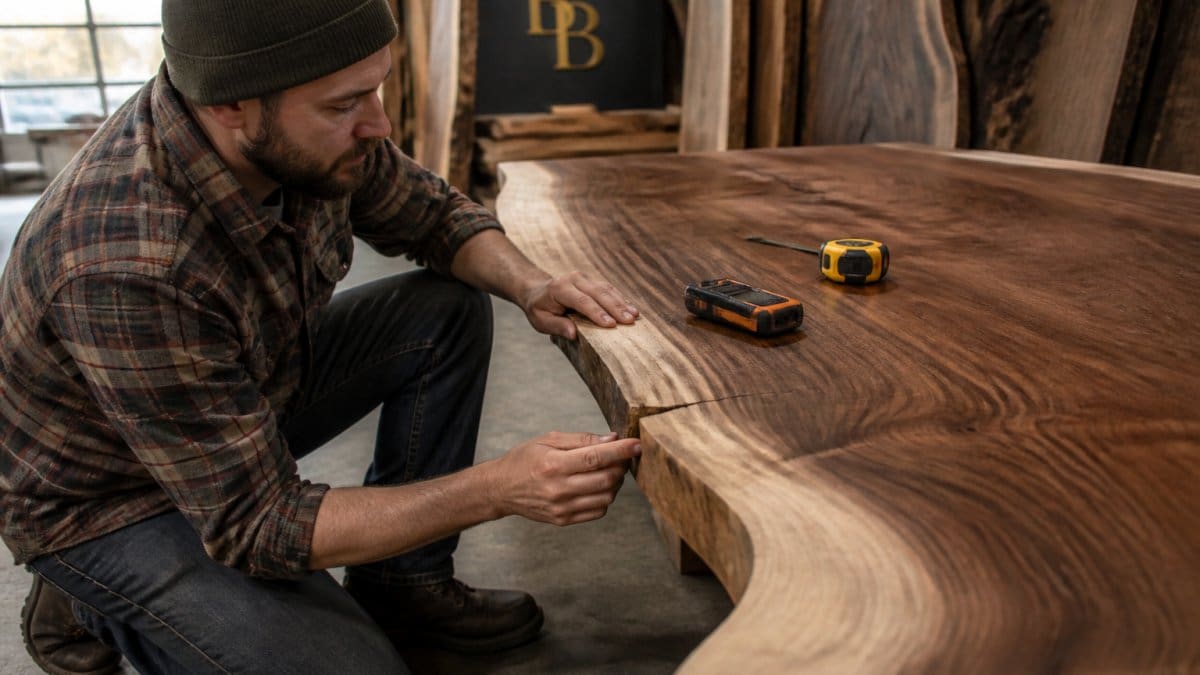
In person:
- Check moisture with your own meter at three spots
- Run a hand along the live edge for soft or loose bark
- Look for cracks, checks, and splits from both faces
Online:
- Request close-up photos of both faces and both ends
- Ask for the moisture reading in writing
- Confirm the exact length, width, and thickness
Live Edge Wood Slab Cost and Usable Yield
Live edge wood slab cost depends on species, size, thickness, and how clean the slab is. Rare species and wide, thick slabs cost more. So do slabs with fewer defects, because more of the wood is usable.
Here is what most buyers miss: the price tag is not the whole story. What matters is usable yield, how much of the slab survives into the finished piece.
The Five Costs Beyond the Slab Price
When comparing two slabs, compare total project cost, not sticker price. The slab is usually the largest line, but rarely the only one.
- Milling and flattening. A rough slab must be flattened on a router sled or wide-belt sander, usually charged by the hour or square foot. A twisted slab takes longer than a flat one, so a cheaper warped slab can erase its own savings at the mill.
- Edge work and defect repair. Bow ties, epoxy fills, and bark stabilization are skilled labor. A slab with several deep checks may need hours of repair before it is structurally sound.
- Shipping or freight. A wide slab is oversized, priced by weight, dimensions, and distance, a few inches wider can jump into a higher freight class. Local pickup avoids this entirely.
- Waste. Every cut for a straight edge, breadboard end, or squared corner removes material. A slab with a wandering live edge and a large bark inclusion may lose more surface area than its dimensions suggest.
- Finishing. Oil, polyurethane, or hardwax finish, plus labor for multiple coats, adds cost that scales with surface area on both faces.
How to Calculate Usable Yield
Usable yield is the percentage of the slab’s surface area that survives into the finished piece. Estimate it before you buy:
- Measure the slab’s full length and its widest and narrowest widths.
- Sketch the finished shape, tabletop, bar top, bench seat.
- Mark where defects fall; any crack, void, or soft pocket inside the shape must be cut out, filled, or stabilized.
An 80 percent usable slab is a better buy than a bigger 50 percent usable one, even if the bigger slab costs less per board foot. Run the math on both before you commit.
A Simple Way to Compare Two Slabs
Divide total project cost by usable square feet to get a cost-per-usable-square-foot figure you can compare across slabs of different sizes and prices.
- Slab A: lower sticker price, 50 percent yield, several hours of repair.
- Slab B: higher sticker price, 85 percent yield, no structural defects.
On a cost-per-usable-square-foot basis, Slab B often wins. The sticker price is a distraction; usable yield is the real number.
Ask the seller how much of the slab is usable and what repairs it needs. A seller who can answer both questions in specifics is a seller who knows the wood. A seller who cannot is a seller who is guessing.
Questions to Ask Before You Pay
- What is the moisture content, and how was it dried?
- What defects are present, and how would you stabilize them?
- What are the exact dimensions, including narrowest width?
Get the answers in writing. A slab is a significant purchase, and the details that decide whether it becomes a heirloom or a headache are the ones sellers are sometimes slow to volunteer.
What to Ignore When Choosing a Live Edge Slab
Ignore hype and focus on what lasts. These matter far less than buyers think:
- A famous species name with no proof of how it dried
- A dramatic grain pattern that hides a structural flaw
- A low price that ignores the cost of repairs and waste
What matters is stability, sound structure, and a slab that fits your project. Everything else is noise.
At The Bronze Burl, we handpick each slab with these checks in mind. We are a family-owned shop.
Frequently Asked Questions
What is the best wood for live edge slabs?
Walnut and oak are the most common choices for live edge slab furniture, with walnut offering darker natural color and oak providing dent resistance for daily use. Elm, poplar, and cypress appear in regional markets, and cedar or pine work well for lighter pieces. The right pick depends on the project: a dining table needs a hardwood that resists dents, while a console or bar top can use a softer species. Check that the slab is kiln-dried or properly air-dried before you commit.
How much does a slab of live edge wood cost?
Live edge wood slab cost depends on species, size, thickness, grain character, and how dry the slab is. A wide kiln-dried walnut slab with strong figure costs more than a narrower oak slab with plain grain. Pricing also varies by region and by whether you buy from a sawyer, a retailer, or a custom furniture maker. Request a quote that lists the slab dimensions and moisture content so you can compare fairly. Expect the final furniture price to include finishing, base, and delivery.
How do I choose the right size live edge slab for a table?
Start with seating capacity and room clearance, not the slab. A dining table typically needs 24 inches of width per person and 30 to 36 inches of clearance on all sides for chairs to pull out. A six-person table often lands around 72 to 84 inches long and 36 to 40 inches wide. Measure your room, tape the footprint on the floor, then look for a slab that fits those numbers. Live edge slab sizes for dining tables vary, so confirm length, width, and thickness before buying.
Are cracks and knots in a live edge slab a problem?
Some cracks, checks, and knots are normal in a live edge slab and add character. The question is severity. A hairline check near the edge can be stabilized with epoxy or butterfly keys. A split that runs through the slab’s structural span, or a void under a leg, weakens the piece and may not be repairable. Insect damage is a separate concern: look for fresh frass or exit holes, since active infestation spreads. Ask the seller how defects were addressed and whether the slab was stabilized before finishing.
Choosing a live edge slab can feel risky when so much rides on getting it right. The Bronze Burl takes that weight off your shoulders with handcrafted furniture, thoughtfully curated home décor, and pieces built to last. As a family-owned business, we treat every slab as if it were headed to our own dining room. Shop the Exclusive Winter Collection and bring home a piece made to be enjoyed for years.