

Live Edge Furniture Shipping Damage Policy
Table of Contents
- What to Do If Furniture Arrives Damaged: First Steps
- Furniture Delivery Inspection Checklist: Before You Sign
- How to Document Furniture Damage with Photographic Evidence
- Filing a Furniture Shipping Damage Claim
- Minor Repair vs. Professional Restoration
- Crating, Packaging Integrity, and Liability
- Conclusion
- Frequently Asked Questions
Last Updated: October 9, 2026
What to Do If Furniture Arrives Damaged: First Steps
A live edge table can take weeks to build and travel hundreds of miles.
The short version: note the damage on the delivery receipt before the driver leaves, photograph everything, and file your claim within the carrier’s time limit.
Live edge furniture shipping damage policy decides who is responsible when a handcrafted piece arrives with structural damage, finish abrasion, or cosmetic defects.
So when a piece arrives damaged, you have three jobs:
- Inspect the crate and the furniture before you sign anything
- Document the damage with photos and written notes
- File the claim inside the carrier’s stated window
Miss any one of those, and the claim usually fails. The Federal Motor Carrier Safety Administration sets the ground rules for freight delivery in the U.S., which is why the paperwork matters so much.
Refusing a Shipment vs. Accepting with Notations
Refuse the shipment when the crate is crushed, the furniture is visibly broken, or the driver won’t let you inspect it. Accept with notations when damage is minor and you want to keep the piece.
- Refuse: The carrier takes the piece back. You file for a full replacement or refund. This is the cleaner option for structural damage.
- Accept with notations: You write the damage on the bill of lading, keep the piece, and file a repair or partial claim. Best for finish abrasion or small cosmetic defects.
Never sign a clean receipt and hope to sort it out later. A clean signature says the delivery arrived in good shape. That signature is the first thing the carrier will point to when you file.
Signing a clean delivery receipt removes your strongest evidence. If you sign without noting damage, the carrier can argue the piece left their hands in perfect condition. Note it or refuse it. There is no third option.
Furniture Delivery Inspection Checklist: Before You Sign
Use this furniture delivery inspection checklist before the driver hands you the clipboard. It takes ten minutes.
- Confirm the crate has no crushed corners, tears, or water stains
- Confirm the crate has not been re-taped or opened in transit
- Ask the driver to wait while you open the crate
If the driver won’t wait, refuse the shipment.
Freight Carrier vs. Parcel Carrier: Why the Protocol Changes Everything
The carrier type determines what document you sign, who inspects the damage, and how long you have to file. Get this wrong and a valid claim dies on a technicality.
Freight (LTL) carriers move live edge tables, benches, and large slabs on pallets through a terminal network where shipments are consolidated, sorted, and re-loaded, every touch point is a chance for damage.
Parcel carriers move smaller décor, botanicals, and boxed accessories. The package is scanned at every hop, and the driver drops it without waiting for inspection.
| Factor | Freight (LTL) Carrier | Parcel Carrier |
|---|---|---|
| Typical items | Tables, benches, large slabs | Small décor, botanicals |
| Document you sign | Delivery receipt / bill of lading | Driver’s scanner or signature pad |
| Delivery type | Curbside or white glove | Doorstep drop-off |
| Inspection window | Before you sign | After delivery |
| Who inspects | Carrier agent on site | You, with photos |
| Claim deadline | Often 5-15 days | Often 14-30 days |
| Concealed damage window | Short, sometimes 5 days | Often 14-30 days |
The Delivery Receipt Is Not the Bill of Lading
The bill of lading is the contract between shipper and carrier; the delivery receipt is what you sign at your door. They’re different documents, and the carrier will use both against you if you’re careless.
When the driver hands you the receipt, you have three options:
- Sign clean. You confirm the shipment arrived in good condition, the worst outcome if there is any damage.
- Sign with notations. Write the specific damage on the receipt before signing. “Crate crushed on rear-left corner, slab crack visible” beats “damaged.”
- Refuse. Decline the shipment and the carrier takes it back. Correct for structural damage or a driver who will not let you inspect.
Never sign a clean receipt and hope to sort it out later. A clean signature says the delivery arrived in good shape. That signature is the first thing the carrier will point to when you file.
Signing a clean delivery receipt removes your strongest evidence. If you sign without noting damage, the carrier can argue the piece left their hands in perfect condition. Note it or refuse it. There is no third option.
What to Do When the Driver Won’t Wait
Freight drivers run tight routes. Asking them to wait ten minutes for a crate to be opened is reasonable, but not always granted:
- Ask first, politely. Most drivers will wait if you explain you need to inspect a high-value piece.
- If they refuse, note the refusal on the receipt. Write “Driver declined to wait for inspection” and sign. That notation preserves your right to file for concealed damage.
- Photograph the crate before the driver leaves. Even a refused inspection is documented by photos of the sealed crate.
Ask the carrier which delivery type you’re getting before the truck arrives, that tells you what document you’ll sign and how much time you have to file.
How to Document Furniture Damage with Photographic Evidence
Photographic evidence is the backbone of any furniture shipping damage claim. Carriers do not take your word for it. They take your photos.
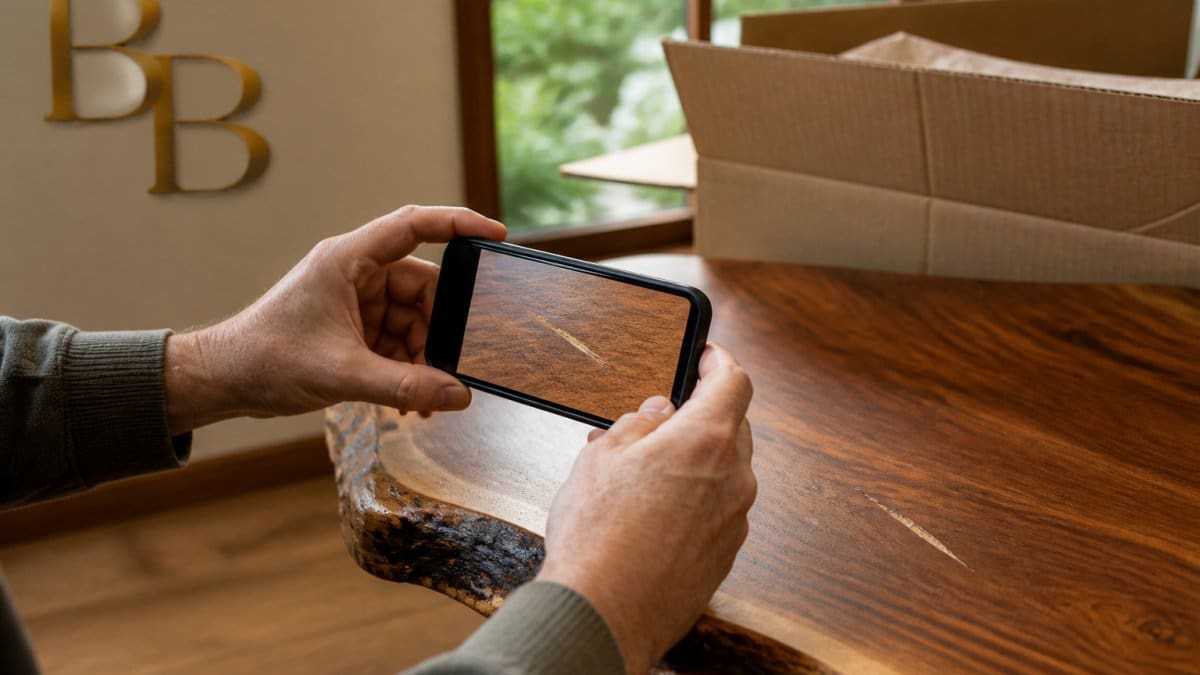
A single photo isn’t enough. You need a story in pictures, from crate to close-up.
Step-by-Step Photo Guide for Your Claim
Follow this sequence:
- Wide shot of the crate before you open it. Show all four sides.
- Close-up of any crate damage. Crushed corners, tears, water marks.
- Wide shot of the piece in the room, fully assembled if possible.
- Mid-range shot of the damaged area from about three feet away.
- Close-up of the damage with a coin or ruler for scale.
- Photo of the bill of lading with your written notations.
- Photo of the shipping label so the carrier can trace the shipment.
Take all seven in one sitting. Daylight is best. Flash washes out wood grain and hides finish abrasion.
Photograph the crate before you open it, even if it looks fine. If concealed damage shows up later, that unopened-crate photo proves the piece was never dropped in your driveway.
Filing a Furniture Shipping Damage Claim
File the claim with the carrier, not the maker, and file fast. The carrier holds liability for transit damage; your maker can help but can’t file for you.
- Contact the carrier’s claims department within the stated window
- Submit your photos and the notated bill of lading
- Keep the original packaging and crate until the claim closes
- Get a claim number and a named contact
- Follow up in writing every few days
The U.S. Department of Transportation publishes consumer guidance on freight claims, including your right to inspect before signing. Use it if a carrier pushes back.
Concealed Damage and Time Limits
Concealed damage is damage you can’t see until after the driver leaves and you unpack. It’s the hardest claim to win because the carrier will argue it happened after delivery. Most carriers require concealed damage claims within days, not weeks, and the clock starts at delivery, not unboxing.
- Open every box within 24 hours of delivery
- Photograph the packaging before you break it down
- Report concealed damage the same day you find it
If you wait a week to open the crate, you will likely lose the claim. Open it the day it lands.
Shop Exclusive Winter Collection →
The single most important number in any shipping claim is the deadline. Note it on your calendar the day the truck leaves. Missing it is the most common reason claims fail.
Minor Repair vs. Professional Restoration
Not every scratch needs a claim. Some damage you can fix yourself in an afternoon; other damage needs a professional. Know which is which before you touch the piece, because the wrong move can void your claim.
The Three-Question Test
Before you open a touch-up kit, answer three questions:
- Does the damage affect structural integrity? If the slab is cracked, a joint is split, or the base wobbles, stop. That is professional territory.
- Is the damage in the finish or in the wood? Finish abrasion and light scratches sit on the surface. Gouges, dents, and water stains that have soaked in go deeper.
- Is the claim still open? If you have filed a claim with the carrier, do not touch the piece until the claim closes. Repairing damage mid-claim gives the carrier a reason to deny it.
If you answer “yes” to structural damage, “deep” to the wood question, or “open” to the claim question, call the maker first.
What Counts as Minor Repair
Minor repair covers surface-level issues that do not change the piece’s structure or stability:
- Light finish abrasion from crate contact
- Small scratches that do not catch a fingernail
- A loose screw or bolt on the base
A touch-up kit, wax or oil, and patience handle most of these. Live edge pieces are usually finished with oil or wax rather than lacquer, making spot repair easier than on a factory-lacquered table.
What Counts as Professional Restoration
Professional restoration covers anything structural or anything that requires sanding back to bare wood:
- Cracks in the slab, even hairline ones
- Split joints or a separated base
- Deep water stains that have penetrated the finish
Don’t fix these yourself. A wrong DIY fix can worsen the damage, void your claim, and cost more to reverse than the original repair.
| Damage Type | DIY or Pro | Why |
|---|---|---|
| Light surface scratch | DIY | Touch-up kit blends it out |
| Finish abrasion | DIY | Wax or oil restores the sheen |
| Loose hardware | DIY | Tighten or replace the part |
| Hairline crack in slab | Pro | Needs stabilization |
| Split joint or base | Pro | Structural, affects safety |
| Water stain, deep | Pro | Requires sanding and refinishing |
| Gouge exposing raw wood | Pro | Color match and refinish needed |
How DIY Repair Interacts with Your Claim
If you file a carrier claim and then repair the damage yourself, you’ve changed the evidence. The adjuster may want to inspect the piece, and if you’ve already sanded, filled, or refinished the damaged area, they can’t verify the original condition.
The safe sequence is:
- Document the damage with photos before you touch anything.
- File the claim and get a claim number.
- Ask the carrier whether they need an inspection.
- Only repair after the claim closes or the carrier confirms no inspection is needed.
If the damage is minor enough that you’d rather fix it than file, that’s legitimate, just make that choice before you file, not after.
When to Call the Maker First
If you’re unsure whether damage is minor or structural, call the maker before you touch it. A two-minute call is cheaper than a voided claim or botched repair. Most makers, including our team, will look at your photos and tell you honestly whether it’s a DIY fix or a professional job.
The U.S. Consumer Product Safety Commission offers guidance on furniture safety and stability, which is worth a look if the damage affects how the piece stands.
Document first, decide second, repair last. The order matters more than the repair itself.
Crating, Packaging Integrity, and Liability
Good crating prevents most damage before it happens. Packaging integrity is the maker’s job. Liability is what happens when it fails.
A properly crated live edge piece uses:
- Custom-cut foam or corner blocks around the slab
- A moisture barrier to protect against humidity swings
- A rigid outer crate that will not flex in transit
Wood slab furniture is heavy and irregular, a generic box won’t protect it. The maker should build the crate around the piece.
Liability usually splits three ways:
- The maker is responsible for packaging integrity and for handing the piece to the carrier in good condition
- The carrier is responsible for transit damage once the piece is in their hands
- You are responsible for inspecting, documenting, and filing on time
When everyone does their part, claims get paid. When one part breaks down, the claim usually fails.
Buyers who want a maker that builds the crate around the piece and stands behind the shipping damage policy from day one.
Conclusion
Shipping damage is stressful but not complicated when you know the sequence: inspect before you sign, document everything, file fast.
At The Bronze Burl, we build every piece to last and crate it to travel. Our handcrafted furniture is made by hand in the Pacific Northwest, and our family-owned team stands behind each piece from workshop to door.
Shop Exclusive Winter Collection and bring home a piece made to be enjoyed for years.
Frequently Asked Questions
What should I do if my live edge furniture arrives damaged?
Inspect the piece before signing the delivery receipt. Note any structural damage or finish abrasion on the bill of lading and refuse the shipment if damage is severe. If you accept it, photograph the damage immediately and file a claim within the carrier’s time limit, usually 5 to 15 days. Contact the seller right away with your documentation.
How do I document shipping damage to a live edge table?
Take clear photos of the damage from multiple angles, including close-ups and wide shots showing the entire piece. Photograph the packaging and any visible exterior box damage. Keep the crating materials and do not discard them. These photographic evidence items support your furniture shipping damage claim and help the carrier process it faster.
Can I repair live edge furniture that was damaged during shipping?
Minor cosmetic defects like small scratches or finish abrasion can often be repaired with a touch-up kit or professional restoration. Structural damage such as cracks or broken joints requires a furniture restorer. Check your shipping damage policy first, as DIY repairs may affect your claim. For significant damage, file a claim before attempting any repair.
What information should I include in a furniture damage claim?
Include your order number, delivery receipt, bill of lading, and dated photographs of the damage and packaging. Describe whether the damage is minor or major, note any concealed damage, and state the delivery window. Submit the claim within the carrier’s time-sensitive window and keep copies of all correspondence for your records.