

Live Edge Table Worth the Price? A 2026 Buyer’s Guide
Table of Contents
- Is a Live Edge Table Worth the Price? The Honest Answer
- Live Edge Table Pros and Cons: What You Gain and Give Up
- Custom Live Edge Table Cost: What Drives the Number
- How to Judge Live Edge Slab Quality Before You Buy
- Live Edge Table Maintenance: The Real Time and Cost Commitment
- Live Edge vs. Conventional Dining Tables: Value for Money
- A Buyer’s Decision Framework: When the Premium Makes Sense
- Frequently Asked Questions
Last Updated: October 19, 2026
Is a Live Edge Table Worth the Price? The Honest Answer
A live edge table is worth the price when the slab is sound, the construction is honest, and you plan to keep it a decade or more. It is not worth it when you are paying for a trend rather than a piece of wood.
That distinction matters more than any number on a quote. At The Bronze Burl, we build live edge furniture from locally sourced timber, and we have watched buyers talk themselves into the wrong slab for the right reasons. The wood is beautiful; the decision still needs a framework.
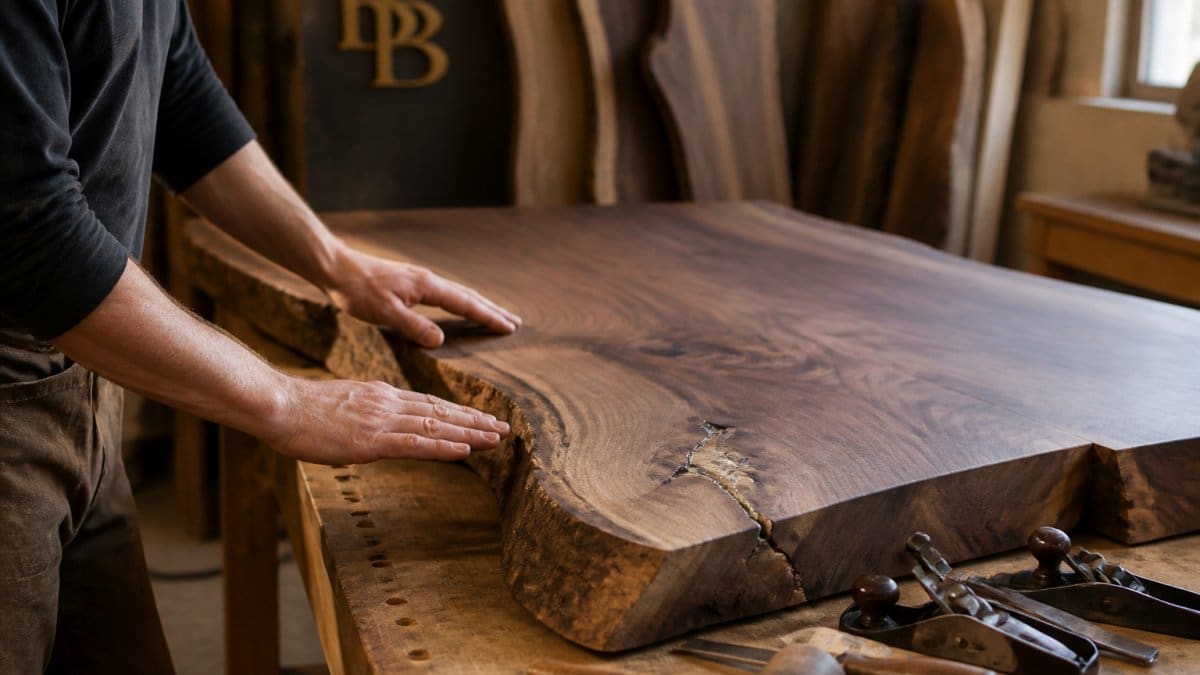
A live edge table is a dining table whose outer edge follows the natural contour of the tree rather than a straight saw cut. The slab keeps its bark line or exposed edge, grain pattern, and natural imperfections, which is why two tables are never identical. That uniqueness is the product, and the reason pricing is hard to compare.
Below, we break down what you actually pay for, where a slab table falls short, and how to judge whether a specific piece justifies its price.
Live Edge Table Pros and Cons: What You Gain and Give Up
The honest trade-off is simple: you gain character and lose predictability. A live edge table brings warmth, grain pattern, and natural color a factory-finished top cannot match, but you give up standardization in sizing, seating, and care.
Where a Slab Table Wins
- One-of-a-kind character. The natural edge and grain pattern make each piece a single object, not a model number.
- Solid wood construction. A well-built slab table can be refinished rather than replaced, which extends its working life.
- Heirloom potential. Handcrafted furniture is often bought to be passed down, not cycled out with the next furniture trend.
- Design flexibility. Custom sizing lets the table fit the room instead of the room fitting the table.
Where It Falls Short
- Irregular seating. A natural edge means the usable seat count varies along the length. Measure before you commit.
- Movement and checking. Solid wood responds to humidity. Small checks and cracks are normal, not defects, but they are not for everyone.
- Weight and handling. Thick slabs are heavy. Moving day is a real logistics problem.
- Care requirements. A live edge table needs periodic oiling or waxing. It is not a wipe-and-forget surface.
The most common mistake is buying a slab for its shape without checking moisture content and how the base attaches. A beautiful top on a base that restricts wood movement will crack within a couple of seasons. Ask how the top is attached before you fall in love with the edge.
Custom Live Edge Table Cost: What Drives the Number
Custom live edge table cost is driven by five factors: species, slab dimensions and thickness, grain and figure quality, base design, and finish labor. None scale linearly, which is why two similar-size tables can sit far apart in price.
Here is what moves the number most.
Species. Walnut carries a premium for its dark color and tight grain; maple offers a lighter, cleaner look; oak brings durability and pronounced grain at a more accessible position.
Slab dimensions and thickness. A thick slab requires a bigger tree and more drying time, and wide, clean-edged slabs are rarer than narrow ones. Length also matters, as long, clean boards are scarcer.
Grain and figure quality. Straight, quiet grain is the working standard. Ask the maker to separate slab price from labor price so you can see which part of the quote is wood and which is work.
Defects and voids. Natural imperfections are part of the appeal, but large voids or checks require epoxy fills and extra work.
Base and finish. A steel base, trestle base, and hand-shaped wooden base are three different projects. A welded steel base, a hand-cut wooden trestle, and hand-rubbed finishes each have different labor and material considerations.
A like-for-like way to compare quotes. Ask every maker to quote the same four things: species and grade, finished dimensions (length × width × thickness), base style and material, and finish type. Without those pinned down, two quotes are not comparable.
We do not publish fixed price ranges because a slab is not a catalog item. Ask for a quote against a specific slab and size, then compare it using the four-point checklist above.
How to Judge Live Edge Slab Quality Before You Buy
Slab quality comes down to four checks: moisture content, drying method, crack treatment, and how the top attaches to the base. Get those right and the table will hold; skip them and no amount of beautiful grain will save it.
Use this checklist on any slab, from any maker:
Shop Exclusive Winter Collection →
- Moisture content. Ask for a reading. Wood that has not been properly dried will move after delivery.
- Drying method. Air-dried and kiln-dried slabs behave differently. Ask which, and why the maker chose it.
- Check and void treatment. Filled checks should be stable, not cosmetic. Ask what was used and how deep it goes.
- Attachment method. The base should allow the top to move. Screws straight through a thick slab with no allowance is a warning sign.
- Finish schedule. Ask how many coats and what product. A thin finish on a dining surface will not last.
- End-grain sealing. Unsealed end grain dries faster than the rest of the slab and invites cracking.
- Sight lines. Look down the length of the top. Twist and cup should be corrected, not hidden by the base.
Ask the maker to show you the underside of the table. The top gets photographed. The underside tells you how the piece was actually built: how the base attaches, whether the slab was flattened properly, and whether the finish was applied evenly. It is the fastest quality read you will get.
Live Edge Table Maintenance: The Real Time and Cost Commitment
Live edge table maintenance is modest but not zero: oil or wax the surface periodically and keep the piece out of direct sun and dry forced-air drafts. The time commitment is a few hours a year; the cost is a container of the maker’s finish.
Routine care. A hardwax or penetrating oil finish wants a refresh once or twice a year on a dining table, more often in a dry climate or a room with forced air.
Prevention is the cheap part. A coaster under a cold glass, a trivet under a hot pan, and consistent indoor humidity do more than any product. Solid wood expands and contracts with the seasons, and the finish slows moisture exchange rather than stopping it.
Repairs and stabilization. Small checks and cracks are normal in solid wood, but a check that opens or a void that crumbles needs attention. Stabilizing a crack with epoxy and a butterfly key is a shop task, and the cost depends on access and finish matching.
Delivery and installation. A thick slab table is heavy and awkward. Delivery is often a line item, and inside placement, stair carries, and base assembly can add to it. Ask upfront whether delivery includes in-room placement and assembly or is curbside only. For a large slab, professional placement is worth the cost, a dropped top is an expensive mistake.
The ownership math. Add purchase price, routine finish, occasional repair, and delivery, then compare that total to buying a conventional table two or three times over the same period. A well-built slab table bought once and maintained can come out ahead, but only if you actually do the maintenance.
Live Edge vs. Conventional Dining Tables: Value for Money
A conventional dining table wins on price and predictability. A live edge table wins on longevity and character, and that is where the value argument actually lives. Comparing sticker prices alone misses the point.
| Factor | Live Edge Table | Conventional Dining Table |
|---|---|---|
| Upfront price | Higher | Lower |
| Uniqueness | One of a kind | Mass produced |
| Material | Solid wood slab | Often veneer or composite |
| Refinishable | Yes, repeatedly | Often no |
| Sizing | Custom to the room | Standard sizes |
| Care | Periodic oiling | Wipe clean |
| Lifespan | Decades with care | Replacement cycle |
| Resale | Holds value as a handmade piece | Limited |
Total cost of ownership is where the comparison shifts: a conventional table bought three times over twenty years can cost more than one well-built slab table bought once. That math only works if the slab is properly built and maintained, which is why the quality checklist above matters more than the price tag.
A Buyer’s Decision Framework: When the Premium Makes Sense
The premium makes sense when four conditions line up: you have the room, you plan to keep the piece, you accept natural variation, and you have verified build quality. Miss any one and a conventional table is the smarter buy.
Run this framework before you commit:
- Measure the room and seat count. A natural edge changes usable seating. If you regularly seat eight, confirm eight fit.
- Confirm the species and slab. Walnut, maple, and oak carry different pricing and looks. Pick the wood, not just the shape.
- Ask for build details. Moisture content, drying method, attachment, and finish schedule. A maker who answers clearly is worth buying from.
- Check the base. Steel, trestle, or wood, make sure it suits the room and the slab’s weight.
- Decide on custom versus in-stock. Custom fits the room but takes longer; in-stock is faster but fixed.
- Budget for care. A small annual spend on finish and a few hours of your time.
If you are weighing a live edge table against a big-box alternative, the question is not which costs less today but which you will still be happy with in fifteen years. For most of our customers, that answer is the slab.
The real challenge is not finding a live edge table. It is finding one built well enough to justify the premium, from people who will answer questions about moisture content and base attachment without flinching. At The Bronze Burl, we are a family-owned shop rooted in the Pacific Northwest, and we build handcrafted live edge furniture from locally sourced timber, made to order and meant to be enjoyed for years. Every piece is finished by hand, sized to your room, and built to be refinished rather than replaced. Get started with The Bronze Burl and choose a table you will still be proud of a decade from now.
Frequently Asked Questions
Are live edge tables worth the price?
It depends on what you value. A live edge table costs more than a factory table because each slab is selected, dried, and finished by hand, and no two are alike. If you want a one-of-a-kind piece that can be refinished and passed down, the premium is easier to justify. If you need a low-cost table for a busy household with young kids, a conventional table usually makes more sense. Compare the slab’s thickness, grain, and joinery before deciding.
Why are live edge tables so expensive?
The price reflects the slab, not just the labor. Large, dry, defect-free slabs are limited, and wide walnut or figured maple pieces are highly sought after. Drying takes months, and voids, checks, and cracks must be stabilized with epoxy or bowties. Add hand-sanding, finishing, and a sturdy base, and the hours climb. Custom sizing and made-to-order work also add to the overall investment. Ask for a breakdown of slab, base, and finish so you know what you are paying for.
Do live edge tables hold their value?
Solid wood tables tend to hold value better than particleboard furniture because they can be sanded and refinished rather than replaced. That said, resale depends on species, slab width, condition, and local demand. A well-built walnut or oak table with stable joinery keeps its appeal; a thin slab with poor epoxy work does not. Treat resale as a bonus, not a guarantee, and focus on construction quality you can inspect.
What does live edge table maintenance actually involve?
Plan on wiping spills promptly, dusting with a soft cloth, and keeping the table out of direct sun and away from heating vents. Most oil-finished tables need a refresher coat every six to twelve months, and a full re-oil every few years depending on use. Use coasters and trivets, and avoid harsh cleaners. Maintenance is modest but real, so factor the time and occasional product cost into your decision before you buy.